Two Picture Book Reviews – Starring Rainbow Fish and DC Monsters

I got both of these books last year sometime via NetGalley and had skimmed them myself but hadn’t read them to my kids until just this week. I can’t say I was super impressed with either, unfortunately. Now, let me say that I do think some of that comes from reading picture books on my Kindle – I’ve done it a handful of times now and I’m not planning to continue. It’s just not a format conducive to enjoying a picture book, in my opinion. I would LOVE to review more kids books, but they have to be hard copy or I can’t get into them. To my kids it’s “special” to read on Mommy’s Kindle, so they want to do more of it but… ugh.

32333016

So, everybody loves Rainbow Fish, right? What’s NOT to love about the original? You Can’t Win Them All, Rainbow Fish is a new(ish) (2017) book in the Rainbow Fish series and aims to teach another moral lesson — in this case, how not to be a sore loser, basically. Most kids are familiar with Rainbow Fish (I think each of my kids has come home from school with Rainbow Fish artwork at least once), so it’s a great way to keep them engaged and learning through a familiar character, but to me this one lacked the charm of the original. Worse, to me it seemed a little forced. Perhaps I’m remembering the original too rosily (is that a word?), but this just didn’t measure up for me. The kids were engaged, but haven’t asked to read it again. So, I give it two stars and I think I’d get a similar opinion from the kids.
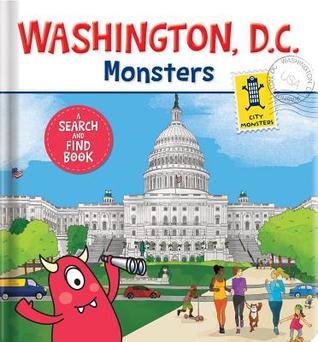
33510848The concept behind this book is fantastic – but at the risk of sounding repetitive, reading it on a Kindle is NOT. We live near DC, and though we don’t take the kids downtown much they were familiar enough with the landmarks to recognize them and get excited about places they’d been. They were especially thrilled with the page about the National History Museum because my husband took them there last week. That said, black and white pictures on a tiny screen made it virtually impossible to find the monsters in the pictures. The text, to me, was, well… fine. It’s a great introduction to DC landmarks and a potentially fun and engaging format for teaching young kids, but to me it falls into that very big basket of kids books that are just so-so and don’t particularly need to be revisited. Another two-star read.

So, on that cheery note I’m going to wrap up. I usually don’t post negative reviews because why? But these came from NetGalley and I figured it’s better to follow through and review even if it’s negative… so there you have it. Next time I write I’ll have something more positive to say.

Book Review: St. George, Rusty Knight and Monster Tamer by John Powell

25814742

When I requested John Powell’s Saint George: Rusty Knight and Monster Tamer from NetGalley sometime last year, I confess I totally thought it was going to be a story of the legend of St. George, who is often portrayed as a slayer of dragons. That, of course, wasn’t the case at all (ha, oops!), but it was a really enjoyable read. Part of the novelty for my daughter was reading together on my Kindle (ooohhh! exciting!), but she really did enjoy the book and so did I.

The Goodreads synopsis is super short:

Humorous tales about an impoverished knight in old England who discovers a way to tame the great variety of monsters that roam the land in the days of Good King Freddie the Umteenth and his prime minister Merlin the Whirlin.

“Humorous” is the perfect word to describe the story. If I remember correctly, Powell says in the beginning of the book that he originally came up with these stories as bedtime stories for his kids – and you can tell! They’re just funny and perfectly geared toward little kids. They follow a predictable structure (all of them start with “Now it was in the days of Good King Freddie…”) and in each story Saint George has to take on some ridiculous monster problem or another – which usually can be solved by providing the monsters with the magical, monster-taming marmorguglehupf cake (my daughter thought that word was hilarious).

The stories are full of all sorts of absurdities with names just as outlandish as marmorguglehupf cake, ideas like George’s “armor-on week” and “armor-off week” (during which he sleeps – for the whole week!), and other silly, non-sensical things (like a king who can’t read!). The crazy names and nonsense action reminded me a good deal of Roald Dahl, and prompted the same kind of laughter from my daughter as did The BFG. There were only two drawbacks for me with the books: 1) each story was a little too long to be a bedtime read-aloud but it didn’t work to break them up so we just pushed through a whole story in each sitting; and 2) there was one entire story that REALLY is not suited for American kids – or their parents! We just couldn’t follow the thread on playing cricket (our loss, though – I’m sure to a British kid the story would’ve been as hilarious as the rest).

All in all, I’d give it 4 stars and definitely recommend it! I think it’ll be another year or two before my next daughter is ready for it, but I’ll look forward to rereading the silliness with her when she’s ready!

Why “The Hobbit” is not just for kids – Reblog from Aleteia.org

I came across this commentary this morning and I think it’s just wonderful. While I haven’t read The Hobbit since high school, it is one of the books (along with Lord of the Rings) that I hope to introduce to my kids when they’re old enough. The author of this commentary, Tod Worner, captures, I think, the essence of why I read and what I hope my children gain from reading. I particularly love the GK Chesterton quote he includes! Please find the original piece here.

Why ‘The Hobbit’ is not just for kids

THE HOBBIT,BOOK,LAYFLAT

Shutterstock
Share

How reading J.R.R. Tolkien’s story to his 10-year-old daughter unexpectedly stirred this father’s soul.

I have a confession to make.

I am just finishing The Hobbit for the first time. And I am almost 45.

Okay, okay. So it’s not scandalous. But to those who consider themselves well-read Catholics, not having read The Hobbit and its three-volume sequel, The Lord of the Rings, is considered perplexing if not irresponsible. After all, they are essential works of the moral imagination.

For years, I have been told how good these books are. In them, tales unfold of an extraordinary quest of unlikely heroes, unimaginable creatures and unexpected twists. Ice-capped mountains and lush valleys, barren hillsides and forbidding forests serve as terrain for a motley crew of unlikely allies who strive and suffer together towards an end much larger than themselves.

And so, earlier this year, my 10-year-old daughter and I decided to embark on reading The Hobbit together nightly as she went to bed.

And it has been extraordinary.

As we walked each night with the diminutive Bilbo Baggins from his cozy home in the Shire to the perilous wide world of Middle Earth, we encountered elves and wizards, trolls and goblins, spiders and orcs. We sensed the constant thrill of the adventure ahead mixed (paradoxically) with the forlorn homesickness for what was left behind. Again and again, we agreed with Bilbo’s skepticism about himself. He is a nimble thief? He is an indispensable member of group of dwarves trekking to reclaim a mountain and its treasure from a hell-spewing dragon? He is a hero? Right. But then, time and again, Bilbo proved he was just a little bit smarter, just a touch braver, just a smidge better than either my daughter or I expected. The little hobbit was growing. And we were growing with him.

But there were no small number of times that I wondered what the devil this hobbit thought he was doing. He had a comfortable home and an easy-going life. His books were well-ordered and his larder was full. His fire was toasty and his room warmly-lit. Why leave it all? Why walk away from the known and predictable for the wild and uncertain? Night after night, just walking with Bilbo into the greater unknown made me pull the comforter a bit tighter and snuggle a bit closer to my daughter.

But, after all, that is what these tales are all about. They remind us of our smallness, but our potential for greatness. They illustrate the peril of living dangerously, but also the risk of not living at all. They re-acquaint us with eternal verities (often considered outmoded) such as duty, loyalty and honor as well as the bright line (forever at risk of being blurred) separating right from wrong and good from evil. They instill in us a devotion to each other and a greater reason for being beyond our own selfish appetites. And they do this all in the form of a parable.

The great southern Catholic novelist Flannery O’Connor once observed,

“I tell a story because a statement would be in adequate.”

Quite right. In a world deaf to platitudes, J.R.R. Tolkien decided to shout with hideous orcs, an incinerating dragon and an intoxicating ring. But the tale isn’t a tale for the sake of telling a tale. Allegories are allegories for a reason. They speak to sins and virtues, temptations succumbed to and temptations resisted, damnation averted and grace received. As G.K. Chesterton once noted,

Fairy tales do not give the child the idea of the evil or the ugly; that is in the child already, because it is in the world already. Fairy tales do not give the child his first idea of bogey. What fairy tales give the child is his first clear idea of the possible defeat of bogey. The baby has known the dragon intimately ever since he had an imagination. What the fairy tale provides for him is a St. George to kill the dragon.

Indeed.

We must remember: The dragon can be killed. The ring can be destroyed. You can endure suffering. You can return home.

Chesterton reminds us,

At the back of our brains, so to speak, there was a forgotten blaze or burst of astonishment at our own existence … The object of the artistic and spiritual life was to dig for this submerged sunrise or wonder; so that a man sitting in a chair might suddenly understand that he was actually alive, and be happy. 

As I was lying there reading The Hobbit to my 10-year-old daughter, I smiled and once again understood.

I am alive.

And I am happy.

Thank you, Todd and Aleteia!