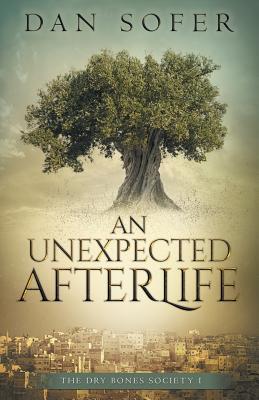
Book Review: An Unexpected Afterlife by Dan Sofer

34348069

Moshe Karlin wakes up one morning, naked and alone, in the Mount of Olives Cemetery. According to his family and friends, he died two years ago, but Moshe is not about to accept his demise lying down.

Is his new lease on life a freak of nature or the start of the long-awaited Resurrection? Moshe doesn’t really care. He vows to beat his “afterlife crisis” and win back his life-and his wife-if it is the last thing he does.

But the road ahead is full of unexpected dangers. Along the way he gains insight into life, love, and the Jewish State, as well as the suspicion that perhaps his perfect first life was not so perfect after all.

Meanwhile, other changes are afoot in the Holy Land. A reluctant prophet prepares to deliver a message of redemption-and the end of life as we know it-when a freak accident changes the course of history.

Readers who enjoy the satire and humor of Kurt Vonnegut, Carl Hiaasen, Terry Pratchett, and Douglas Adams will enjoy this intriguing and humorous mystery in the Jewish lore and legends of the Resurrection, the World to Come, and the Messianic Era.

Seems at first like a strange book for a Catholic to read, right? It was actually really intriguing and educational for me and I enjoyed it enough to really want to read the sequel (though not SO much that I’ve already read it)! I’m not sure whether a Jewish person would say the same, but I didn’t have any religious qualms with it (say, like how I won’t read Dan Brown’s DaVinci Code because I have no interest in reading what I consider to be blasphemous things about Christ). Rather, for me, the book served to educate me a bit on Jewish theology and thought.

When Moshe comes back from the dead he ends up staying at the home of a local Rabbi, who is convinced that Moshe (and others in his situation) herald the coming of the Messianic era. He says, “The Messianic Era. We believe that the End of Days will see the Resurrection of the Dead, the return of Elijah the Prophet, and the revelation of the Messiah-King, son of David.” (Loc 290) A lot of what the Rabbi then does, in terms of hosting Moshe, engaging with his Rabbinical colleagues/superiors, etc., assuming it is factually-based, sheds a lot of light on Jewish culture and religious organization – which, admittedly, I know little to nothing about.

I was struck by the similarities with Catholicism, though I’m not sure why – after all, Christ was Jewish and His Church descended from Judaism. I noted while I was reading that the Rabbi broke bread and gave it and wine to his guests, just as Christ did at the Last Supper. The Rabbi’s explanation of life after the Resurrection–at least in terms of the healing of the body–is very similar to Catholic teaching. I also noted that the explanation given for trust put in the “leading Rabbis of the generation” (Loc 2364) is strikingly similar to the Catholic Magisterium – we believe that the Holy Spirit guides the leaders of the Church to the right conclusions and therefore we trust in their authority.

There is a fascinating discussion by scientists in a hospital setting about having obtained “scientific proof” that all people descended from a single female. It would be fascinating if such proof actually existed! It was a great reminder, though, of science being part of mankind’s search to understand the world that God created, and that, therefore, no person of faith should ever fear science nor see science and religion as incompatible.

These are the lasting impressions I had of the book, but all of these insights gained were wrapped up in a compelling narrative with relatable, realistic characters. I was invested in Moshe’s survival and his efforts to win back his wife, as well as the life of the “reluctant prophet” described in the book blurb. I was also struck by the all-too-realistic exploitation of the resurectees (is that a word?) by criminal elements out to profit only themselves.

All this is to say: it’s an enjoyable and realistic read that also caused me to think and to learn, which is what I love in a book. It was entertaining AND edifying!

Four stars!

Book Review: Spaghetti Head by Sarah Tyley

I’ve probably said a million times that one of the things I love about being a book-blogger is the opportunity to read new and interesting books by indie authors. Spaghetti Head by Sarah Tyley is a perfect example of why!   
Spaghetti Head

I received an ARC of the book from Sarah after weighing in on her book blurb via Twitter and I’m SO GLAD I volunteered to take the few minutes to comment on her blurb and get to “meet” Sarah, and through her, Nell and Sid/Cyd.

This book truly defies classification. There are sci-fi elements, as it’s set in the future with all sorts of new technology and gadgets — some of it scares me, to be honest. I’ve read and blogged a bit about AI before – freaks me out. No doubt it takes a lot of creativity to come up with the future world and all it’s accompanying technological advances (which, truthfully, seem mostly plausible).

Beyond sci-fi, there’s the whole post-apocalyptic thing – which really is two-fold. First, there’s the new world order and governance structure (The System) that comes about. Tyley creates an entirely new system of world government, taking gender, technology, and–she seems to argue–inevitable power struggles into account. Along with this, she adeptly brings to life the societal structures and shows us how people actually live in this new world order. The second and equally important part of the post-apocalyptic story: what was The Disaster? This Tyley does equally well. It’s introduced very creatively, weaving the backstory seamlessly into the action of the story. It’s also very believable — I think most readers are at least vaguely familiar with the natural phenomenon (no spoilers!) that Tyley employs to bring about the destruction of the Earth as we know it. It was one of my favorite parts, a super important and fully-fleshed out history for what could easily have been treated as an afterthought to the story.

Sci-fi, apocalypse… what else? Romance! Motherhood! Relationships! These are central themes without being so overpowering that the book would only appeal to women. The book has so many angles to it that I think it could be universally enjoyed.

The parts of the book that are most memorable and with which I identify the most involve mental health and mental health treatment. Nell attends a multi-week mental health “retreat” of sorts to help her deal with her inner voice and unravel the “spaghetti” in her head. The mental imaging techniques used in the treatment would be AMAZING if they truly existed – I couldn’t help but wonder what my own treatment would look like with such techniques available. Having experienced a significant amount of intensive mental health treatment, I also felt that Tyley’s portrayal of therapy techniques, as well as the characters’ varying paths to recovery–including how much effort they must expend, even when treatment is “over”–were spot-on just like so much of the rest of the book. It’s believable and really realistic.

Overall, there are so many complicated aspects to the novel that Sarah Tyley weaves together flawlessly. I am impressed by the creativity and depth of knowledge she demonstrates in writing such a complicated and yet utterly relatable story, not to mention the incredible amount of effort it must have taken to put that story into words and edit it to a point where it reads so smoothly!

Five stars!

** Thank you to Sarah Tyley for a free copy of the book in exchange for an honest review!

Book Review: The House of the Soul by Annie Dawson

The House of the Soul: A Novel

Ok, friends, this book was SO GOOD that I’m seriously embarrassed it took me so long to review. I read this book almost all in one night, while I held my newborn on the couch because it’s the only way she’d sleep…I would have finished it all that night but my Kindle died around 3am and I was forced to watch TV instead. That child is now 18 months old… so, it’s been a LONG TIME. But anyway – the book!

This book was EXCELLENT. Part of the book synopsis says, “THE HOUSE OF THE SOUL is a journey of love, loss, and friendship, and a treasure map for anyone brave enough to embark on the precarious voyage of self-discovery.” And it’s true — but it spoke to me most because the central character is a mother. The book follows Ella as she struggles to figure out if there’s “more” to her than “Mom,” and how to reconcile her past (educated, photographer, Peace Corps volunteer) with her current life (stay-at-home-mom of two). I think any woman who has struggled with motherhood and personal identity will identify with Ella’s struggle.

We follow Ella as she struggles with friendships, her marriage, and herself and ultimately see that it’s only Ella who has lost her ability to see all the varied parts of herself. Her true friends and her husband know and recognize Ella for the woman she was, is, and will continue to be.

I identified David (her husband) with my husband for the care and love he shows Ella both in allowing her to explore her own insecurities and struggles and in the support he shows for her as a person.

Beyond the sort of heavy life themes, the book appears to be semi-autobiographical and gives us some insights into life as a Peace Corps volunteer in Ghana, which is super interesting!

Overall, fantastic book – well-worth a read, particularly for women in the throes of the self-evolution that comes with parenting!

Five stars!

(Sorry, I forgot to mention: I received this book for free in exchange for an honest–though very belated–review. Thank you!)