My Favorite Dr. Seuss Quotes

Inspired by the season (and notwithstanding last year’s similar post – I guess I’m predictable), I thought I’d share my two favorite Dr. Seuss quotes:

Then the Grinch thought of something he hadn’t before! “Maybe Christmas,” he thought, “doesn’t come from a store. Maybe Christmas…perhaps…means a little bit more.”

– How the Grinch Stole Christmas

AND

A person’s a person, no matter how small.

– Horton Hears a Who

Oh the Places You’ll Go and The Lorax round out my top four Dr. Seuss books but I found I just couldn’t pick a favorite quote from either one – there are too many, and the books pack in so much wisdom that you really need to read them in their entirety.

That’s all for today! I’d love to hear your favorite Dr. Seuss books and/or quotes. There are still a handful I haven’t read so maybe you’ll inspire me to pick up a new one!


Reading to kids – it’s also about values

So I’ve talked before about the importance of kids’ books for teaching language to children, but there’s also a lot to be said for using literature to transmit values. I believe we need to be intentional about what we read to our children. By this I am referring both to what we choose to read and what we choose not to read. I could rail against all the garbage being written for kids these days (and always, it’s not all new), but in the interest of keeping things positive I’m going to just mention one valuable story we read in my house recently.

Frog and Toad All Year (Frog and Toad, #3)

We love Frog and Toad (you know that already, though, because I mentioned them in my last post, too) and recently got Frog and Toad All Year from the library. My absolute favorite story in the book, and the inspiration for this post, is The Surprise, in which Frog and Toad each secretly rake each other’s leaves. They each independently come up with the idea and do the good deed in secret. Then the wind blows all the leaves out of the piles, undoing their hard work; when each returns home, he finds his own yard a mess and never knows what the other did for him. The best part of the story is that Frog and Toad each go to sleep that night happy to have helped a friend, never finding the need to take credit for it. Each of them is happy just to have done a good deed, without needing or seeking credit.

This is love in its truest sense  – seeking the good of another just for the other’s sake. I’m not sure if my kids understand the message of the story, but it has certainly served as a reminder for me to check myself every time I want to say to someone, “oh, hey – did you see this nice thing I just did for you?” I know that books teach us (there’s a reason I called this blog “The Edifying Word”), but reading The Surprise was, for me, a reminder of the power of stories teach values and not just facts.

I’ve generally been pretty good at screening out the “bad” from what my kids read (at home, anyway – I can’t control that my daughter’s teacher reads Junie B. Jones with all her sass aloud to the class). My goal going forward is to remember the power of teaching positive values rather than just avoiding the things I don’t approve of, and using that as a guide for choosing what we read. We learn by repetition, and if I repeatedly and intentionally expose my children to the values I want to instill in them, they will absorb the message; literature is one of many tools I have as a parent to do so.

What do you think? Any suggestions of other positive, edifying books for kids?

What’s with all the bad grammar in kids’ books?

So, here’s a little rant that has me wearing both my “editor” and “mom” hats at the same time.

I’ve been consistently impressed by my oldest daughter’s vocabulary and grasp of grammar as she gets older (almost 6! where does the time go?). I commented recently to my husband how impressive it is that she corrects her own grammar aloud and he said, “It’s because she reads.” And she does (The Boxcar Children at age 6? Seriously? Blows me away. But I digress.).

The conversation got me thinking.

Our kids learn the English language through what they hear spoken around them and from what they read, whether it is read aloud to them or they read on their own. I have three kids – only one is old enough to be reading on her own, the others need to be read aloud to. SO – being crazy about grammar (but I’m lightening up as the language evolves…grr), it DRIVES ME NUTS when picture books have poor grammar. If I want my kids to learn to speak properly, they need to hear the language used properly.

An example: One of my middle daughter’s favorite books, and mine, is Ping Pong Pig.
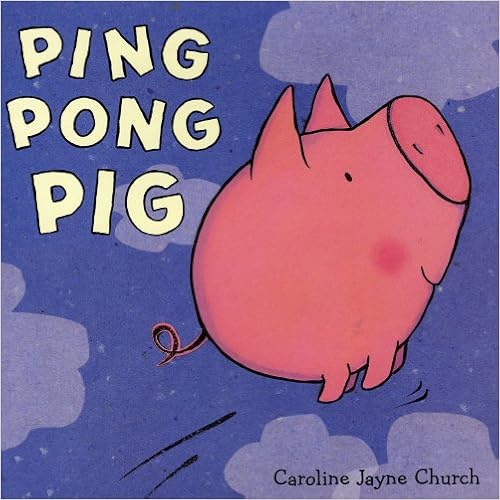
It’s a fun story about a pig who is too busy trying to fly to help with the chores on the farm. Then his friends intervene and build him a trampoline so he can “fly.” Touched by their generosity, Ping Pong uses his new trampoline to fix all the messes he made on the farm while trying to fly. The whole “when pigs fly” thing is lost on the kids, but it’s a fun story.

BUT. And this has bugged me for the entirety of the six years I’ve been reading the book. One of the last pages says: “Until something caught their eye.” Apparently it’s no longer up for debate whether “they” can be used as a gender-neutral singular pronoun (it can, though it still grates on me). At first glance, that might appear to be the case here, but it’s not. “Their” refers to Ping Pong’s friends — plural. Therefore, they cannot have an “eye;” proper agreement dictates that it read “eyes.” So, it should read, “until something caught their eyes.” Now, I recognize that this sounds silly but that’s just my point: we are conditioning ourselves and our children to poor grammar by filling our picture books with it. It starts to sound so normal that proper grammar all of a sudden sounds bad. Truth be told, I would just rephrase the whole thing to something that sounds better, such as, “until they noticed something,” to avoid the awkwardness. But I digress again.

So, my “editor” hat says, “PLEASE let’s do a better job editing our picture books,” because I’m offended by poor grammar. But my “mom” hat says, “PLEASE let’s do a better job editing our picture books,” because I want my kids to learn to speak correctly.

Clearly, Ping Pong Pig is not the worst offender — I’ve read much worse, and it hasn’t ruined my kids. BUT I’m debating going through all our picture books and eliminating every one with poor grammar.

That, or writing in edits like my dad always did to the newspaper.


Thanks for listening to my rant! Do you share my sentiments? Have you seen any offenders out there I should watch out for? Finally, if you are writing a picture book and need an editor, I’m happy to help!