Is it an idiom?

Image result for clipart idiom

So it has been suggested to me by one of the smartest people I know that “something caught their eye” is an idiom, rather than bad grammar. Further, this person (who knows me kinda well…) suggested I don’t like it because it’s an idiom and therefore not formal English.

A few thoughts:

  • If it’s an idiom, it’s a dumb one and I still think it sounds bad.
  • I’m not opposed to idioms, in and of themselves. They reflect a common culture, and therefore form an important part of language.
  • That said, they are not formal English and so sometimes (ok, maybe a lot of times) I don’t like them. I think it’s more important for them to be used appropriately – it’s important to avoid too much cliché in good literature, for example. Idioms have a place in children’s books in order to teach our kids that cultural aspect of language.
  • When I was studying Italian, I really struggled with idioms because they defied all grammar rules. I guess that’s true in English, too, and apparently I struggle a little with them even in my native language.

Maybe I don’t like idioms…

Thoughts?

What’s with all the bad grammar in kids’ books?

So, here’s a little rant that has me wearing both my “editor” and “mom” hats at the same time.

I’ve been consistently impressed by my oldest daughter’s vocabulary and grasp of grammar as she gets older (almost 6! where does the time go?). I commented recently to my husband how impressive it is that she corrects her own grammar aloud and he said, “It’s because she reads.” And she does (The Boxcar Children at age 6? Seriously? Blows me away. But I digress.).

The conversation got me thinking.

Our kids learn the English language through what they hear spoken around them and from what they read, whether it is read aloud to them or they read on their own. I have three kids – only one is old enough to be reading on her own, the others need to be read aloud to. SO – being crazy about grammar (but I’m lightening up as the language evolves…grr), it DRIVES ME NUTS when picture books have poor grammar. If I want my kids to learn to speak properly, they need to hear the language used properly.

An example: One of my middle daughter’s favorite books, and mine, is Ping Pong Pig.
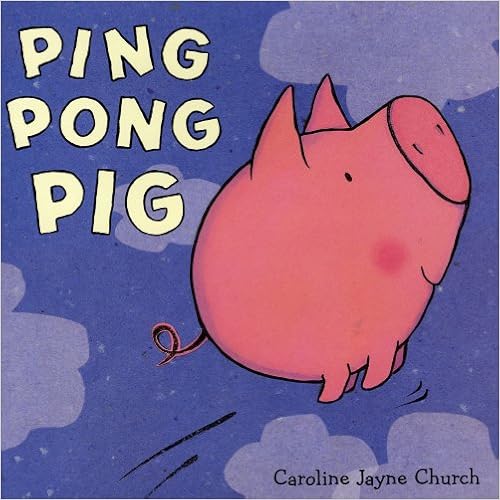
It’s a fun story about a pig who is too busy trying to fly to help with the chores on the farm. Then his friends intervene and build him a trampoline so he can “fly.” Touched by their generosity, Ping Pong uses his new trampoline to fix all the messes he made on the farm while trying to fly. The whole “when pigs fly” thing is lost on the kids, but it’s a fun story.

BUT. And this has bugged me for the entirety of the six years I’ve been reading the book. One of the last pages says: “Until something caught their eye.” Apparently it’s no longer up for debate whether “they” can be used as a gender-neutral singular pronoun (it can, though it still grates on me). At first glance, that might appear to be the case here, but it’s not. “Their” refers to Ping Pong’s friends — plural. Therefore, they cannot have an “eye;” proper agreement dictates that it read “eyes.” So, it should read, “until something caught their eyes.” Now, I recognize that this sounds silly but that’s just my point: we are conditioning ourselves and our children to poor grammar by filling our picture books with it. It starts to sound so normal that proper grammar all of a sudden sounds bad. Truth be told, I would just rephrase the whole thing to something that sounds better, such as, “until they noticed something,” to avoid the awkwardness. But I digress again.

So, my “editor” hat says, “PLEASE let’s do a better job editing our picture books,” because I’m offended by poor grammar. But my “mom” hat says, “PLEASE let’s do a better job editing our picture books,” because I want my kids to learn to speak correctly.

Clearly, Ping Pong Pig is not the worst offender — I’ve read much worse, and it hasn’t ruined my kids. BUT I’m debating going through all our picture books and eliminating every one with poor grammar.

That, or writing in edits like my dad always did to the newspaper.


Thanks for listening to my rant! Do you share my sentiments? Have you seen any offenders out there I should watch out for? Finally, if you are writing a picture book and need an editor, I’m happy to help!

A Curse That Bites Deep

You all will recall my reviews of The Fever and The Mossback Cafe Cookbook by Thomas Fenske. SO good! Well, I finally finished his latest, A Curse That Bites Deep, and now I can’t wait for book 3!!!

Picture

Much like when I read The Fever, I thought the beginning of the book was nice and steady – I was happy to read a chapter or two in a sitting and come back when I had more time. This, unfortunately, coincided with the birth of my now nine-month-old baby, and I took a looooooong break from reading it. So, in the mood for fiction, I picked it up again a week or so ago. Again, like The Fever, but better(!), the story picks up partway through. I binge-read the rest of the book over two nights, staying up way too late to finish. The kids get up at 6… I get up with the baby lots of times in the night…sleep is crucial. And I sacrificed sleep to read this book! I DON’T do that anymore.

I loved in The Fever how the characters and story were so real. That same authenticity carries through in A Curse That Bites Deep. The story is rounded out and made believable by the nuances of the characters, and the author presents so much life wisdom through them. In one scene, for instance, Sam reflects on his life as he washes dishes at The Mossback, noting that “his life was a tradeoff” in which he balanced pursuing the mine and his relationship with Smidgeon (15). Isn’t life full of tradeoffs for all of us? Life requires constant assessment and reassessment of priorities and how well our actions align with those priorities. Sometimes we do well, and sometimes we don’t. Sam experiences this same reality throughout the book.

Another “real” moment that I love, probably because I’m Catholic, is Fenske’s portrayal of Smidgeon’s relationship with the Catholic faith she was brought up in. Through Smidgeon and her respect for the Church and its sacraments, Fenske very powerfully conveys the loving reality the Church teaches. Due to life choices at odds with Church teaching, Smidgeon is unable to participate in the sacraments, particularly the reception of Holy Communion. She tells Sam, “I can’t fully participate but…well, you know, it doesn’t mean I can’t be a part of the church family” (45). This is so beautiful and powerful – it speaks a truth that is often misunderstood by those inside and outside the Church, and it felt nice to read it so simply put in an otherwise-nonreligious book.

So these are the kind of things I enjoyed in the “slower” part of the book.

And THEN. Oh my. The action starts! I don’t want to give away too much of the story, so I won’t get into details. I will say this, though – I was surprised a LOT, which was fun. I mean, I knew there had to be bad stuff going on — it’s about a curse, after all — but there was so much I didn’t see coming and I really enjoyed that. I’d have these moments of shock and just have to keep reading. Accidental deaths, murders, arson, ghosts! All revolving around a gold mine in west Texas, of course. I figured out the identity of the villain well in advance of when it was definitively revealed, but even that didn’t keep me from being surprised by the action.

All-in-all, it was a fun read – surprising and compelling and yet also reflective of so many realities.

Five stars!