This Memorial Day, let’s remember

I’ve been meaning to write about this for a while, and Memorial Day seems like a fitting time. It’s one of those holidays that is so often celebrated so differently from its original intention; it’s no wonder, because it’s hard to do what the day asks us to do: remember those who have given their lives in service to our country. Someone too familiar with loss once said to me that Memorial Day and Veteran’s Day should be reversed — we’re supposed to remember those who died on Memorial Day, but instead we celebrate the beginning of summer; Veteran’s Day is to honor those who have served and have lived, but it comes as the weather is getting darker and colder. I think of this every year as each day approaches, and strive to remember and to appreciate what others have given for my benefit.

Lately, I’ve been remembering by reading and learning. A couple of months ago I fell into a sort of self-study of World War II. I had read The War That Saved My Life with my daughter, which follows a young girl who is forced to leave London and live with another family in the country, safe from the bombs expected to come any day. It was engrossing, and I bought myself the sequel at the kids’ next school book fair. Around the same time, I spent a night on the USS Hornet, a WWII-era aircraft carrier, with my daughter and some other Cub Scouts and their parents. I learned all about the war in the Pacific Theater, to which I really hadn’t ever given much thought. I knew about the atomic bombs, of course, and I had some vague idea of American pilots dying over the ocean – my paternal grandmother lost her then-fiance in the Pacific Theater (more about that later).

Then COVID-19 happened and I spend a week in quarantine in my guest bedroom, during which I read a lot of books I’d been meaning to get to but hadn’t had time for. These included the aforementioned sequel, called The War I Finally Won, and Lee Richie’s Black Bones, Red Earth, which isn’t about the war at all but taught me about the struggles of Bristish WWII orphans shipped to new homes in Australia after the war. These books helped open my eyes to hidden parts of the war, things I’d never learned about or understood, and reminded me of the cascading effects of war on everyone. Every lost life affects multitudes of people around them.

My interest piqued, I next picked up Angela Petch’s The Tuscan Girl, which tells another unseen side of the war: the reality of the ground war in Italy and the lives of Italian POWs, who I had no idea spent a great deal of time in England, helping work the farms while British men were away fighting. It caught my eye because my maternal grandmother lived in Italy during WWII, though not in Tuscany, and I welcomed the opportunity to learn about what her life may have been like.

Continuing on the theme of learning about aspects of the war with which I was previously unfamiliar, I happened upon a Kindle deal for The Things Our Fathers Saw, Volume I, which is a compilation of personal accounts from soldiers and marines who fought in the Pacific Theater in WWII. I was shocked by the brutality of the fighting, the fierceness and ideology of the Japanese, and the astounding numbers of men killed on both sides. And I was humbled by the candor and the emotions of these men who lived through hell on earth, witnessed and participated in so much depravity, and then went home to live “normal” lives. Again, I thought of ripple effects. The scars these men carried home were physical and emotional, and surely impacted their wives, children, and grandchildren. In a way, all of our lives have been shaped and impacted by what feels like ancient history to today’s kids, who may not know anyone personally who lived through that time.

In that book, they kept mentioning Eugene Sledge, with whom a few of the men profiled had served, so I used a Great on Kindle credit to purchase his first book, With the Old Breed: At Peleliu and Okinawa, which was one of the books used to make the HBO miniseries The Pacific. My husband and I then watched the ten-part series, which visually presented many of the battles I’d read about in The Things Our Fathers Saw. It’s an emotionally draining series to watch; in many cases the homefront episodes were worse in that way than the battle episodes. But for the first time, The Things Our Father Saw and The Pacific showed me what the Pacific Theater actually entailed. As a kid, it was equated for me with the black and white photo of Grandma’s fiance, Joey, who was shot down over the Pacific. My child-brain turned this into a neat, non-fiery plane crashing into the Pacific Ocean off the coast of California; a sort of sanitized picture. For the first time, I understand that these men–people’s husbands, brothers, fiances, sons–were fighting brutal battles on tiny island specks thousands of miles away from home, against an enemy that preferred death to surrender. It is tragic, both the loss of life and the emotional burdens placed upon an entire generation of men who survived the brutality. Mixed up in these emotions, though, is this weird sense of gratefulness to Joey – for fighting, but also for dying. Had he not lost his life, I would not ever have been born. My grandmother would never have met my grandfather, who himself fought in the war in the US Navy in North Africa, and wouldn’t have had my dad, who wouldn’t have had me. Ripple effects.

So, my WWII reading list is still growing, of course. I just started reading Sledge’s book, which is apparently considered a military classic. I also have a scanned copy of my grandather’s journal, written as he crossed the Atlantic en route to Libya as a young Navy Lieutenant. This journal came into my family’s possession after my grandfather had passed, and I wish we had had the opportunity to talk to him about it. But, though intensely proud of his service, he rarely talked about the war, so perhaps it is better this way. I also have on my Kindle a book about US-Japanese relations, and how they’ve been shaped by the Pacific Campaign, which I happened upon via a chain of tweets that started with Japanese Literature. Switching back to the European theater, my husband and I are planning to watch Band of Brothers together, and he helped my six year old pick out a book for my birthday, Erik Larson’s The Splendid and the Vile. I have to intersperse happier reading among all this war, but I am so grateful to have stumbled into this self-study. I am learning so much, about history but also about humanity and how WWII shaped not only The Greatest Generation, but those of us who have come after.

I realize my musings have been a mix of focusing on both those who have lived and those who have died, but really it all points to intense sacrifice. So, I hope you all have a Blessed Memorial Day, and take some time to reflect on the many, many men and women who have given their lives in service of our country, and on those they’ve left behind, who suffer the ripple effects of their deaths.

This post is written in thanks, particularly to Joey, whose death indirectly brought about my life, and to Sgt. Alessandro Carbonaro, USMC, whose death during Operation Iraqi Freedom will always cause me pain and has made it so I will never forget that each casualty number represents a human being.
Indie Author Spotlight: Reina Williams ~ Sweet, Cozy Fiction from a local (to me) author!

Indie Author SpotlightThanks for coming back for week seven of Indie Author Spotlight by The Edifying Word, and welcome to all of you who are newly following me! I’m really loving getting to read so many new indie authors and introduce them to you. I would love it if you would support their writing, and tell your friends about them! My list of authors is growing, so look out for more, and a continued variety of genres. Today I’m talking to Reina Williams, who writes sweet, cozy fiction.   

______________________________________________________________________________

True to plan, I read one of Reina M. Williams’ books before writing up this post, and it was a fun, enjoyable read. Being “new” to California and living just outside the Bay Area, I selected one of her California Fairy Tales Series, and it was a lot of fun to read a story set in this general area and see how many places I could recognize. Please read on to learn about Reina and her writing! 

Your website says, “cozy, sweet reads.” Can you expand for us on what genre you write in?

I write sweet, kisses-only romance, both contemporary and historical. Works in progress also include cozy mystery (historical), historical fiction, and children’s fiction. My hope when I write is to tell sweet, heartwarming, uplifting stories that leave us all with a smile. 

Certain Sure definitely left me with a smile, even if I was super frustrated with some of the characters at some points of the story! Where do you get your ideas, and do you outline or plan?

Stories come to me and want to be told, so I write them; I’ve been writing since I was a child, but I only started writing novels in 2009. I don’t plot – I’m definitely a panster, though I wish I could be a better plotter!

How do you fit writing into your life?

Often, I don’t fit writing in. After ten years of indie publishing, it’s become more challenging, especially with the state of the world, my personal life, and my two sons’ challenges as they’ve transitioned to their teen years. As a single mom, I strive to put my sons’ needs first (alongside my own health and well-being), which means writing gets pushed down the priority list often. Writing also, practically, has to come behind more steady paying work, though right now I’m only working as a freelance editor, and homemaker, aside from the business of being a writer. Incorporating tiny habits into my life (like just committing to write for fifteen minutes a day) is something that has kept me writing and works best for me as a working single mother.

Despite the difficulty of fitting it in, you’ve been quite prolific – your Goodreads author page lists 20 books! I assume there are more to come; can you tell us about them? 

Books four and five of The Montana Matchmakers, a contemporary sweet romance series, are in progress and will be out this summer. Return to Pemberley, an early-Victorian set Pride and Prejudice/Sense and Sensibility trilogy that follows the children of the characters from those novels, will be out at the end of 2020.

Do you enjoy reading in the same genres you write in? Do you have any favorite books you’d recommend we check out?

I have too many favorites to name! Mostly, I read sweet romance, Christian romance and fiction, gentle fiction, cozy mystery, YA, children’s fiction, and nonfiction. Favorites from 2019 include: Unmarriageable (Kamal), Other Words for Home (Warga), A Hope Divided (Cole), There’s Something About Sweetie (Menon), I Wanna Be Where You Are (Forest), Some Places More Than Others (Watson), Sugar Lake series (KM Jackson), and the Lady Sherlock series (Thomas). Also, my current favorite rereads are Jan Karon’s Mitford series, Miss Read books, and Susan Wittig Albert’s Cottage Tales.

So, where can we get your books?

My books are available on Amazon, Apple, Kobo, Barnes and Noble—most of the ebook retail sites. Some are also available in audio on Audible, and you can request print and ebook copies from your local bookstore or library. I love libraries!

Learn more about Reina M. Williams or buy her books at the links below: 

www.reinamwilliams.com

Amazon

Books 2 Read (all other sites)

Facebook | Twitter | Goodreads | Pinterest


______________________________________________________________________________

Would you like to be featured, too? Please contact me at kristin@theedifyingword.com!

Indie Author Spotlight: EJ Fisch ~ Science Fiction/Thriller mashup!

Indie Author SpotlightWelcome to week SIX of Indie Author Spotlight by The Edifying Word. We’re switching genres this week to sci-fi, with a sort of thriller twist. I used to think I didn’t read sci-fi (I wrote a post about that once), but really I find myself reading and enjoying it more and more. Doesn’t hurt that my 8yo seems to like it, so I end up reading some with her, too. I’m please to introduce you to EJ Fisch, who will talk to us a little about herself and her writing!   

______________________________________________________________________________

One of the coolest things about putting together this series is that I’ve gotten introduced to so many new books. I’ve been doing my best to read at least one book from every author I feature, so when EJ Fisch expressed interest in participating I picked up her first book, Dakiti, which I just finished a couple of days ago. I really enjoyed it, and do plan to read the rest of the series. 

So, broadly speaking you write sci-fi. After reading Dakiti, I feel like it’s a little bit of a cross with thriller, though. Are all your books a hybrid like this one?
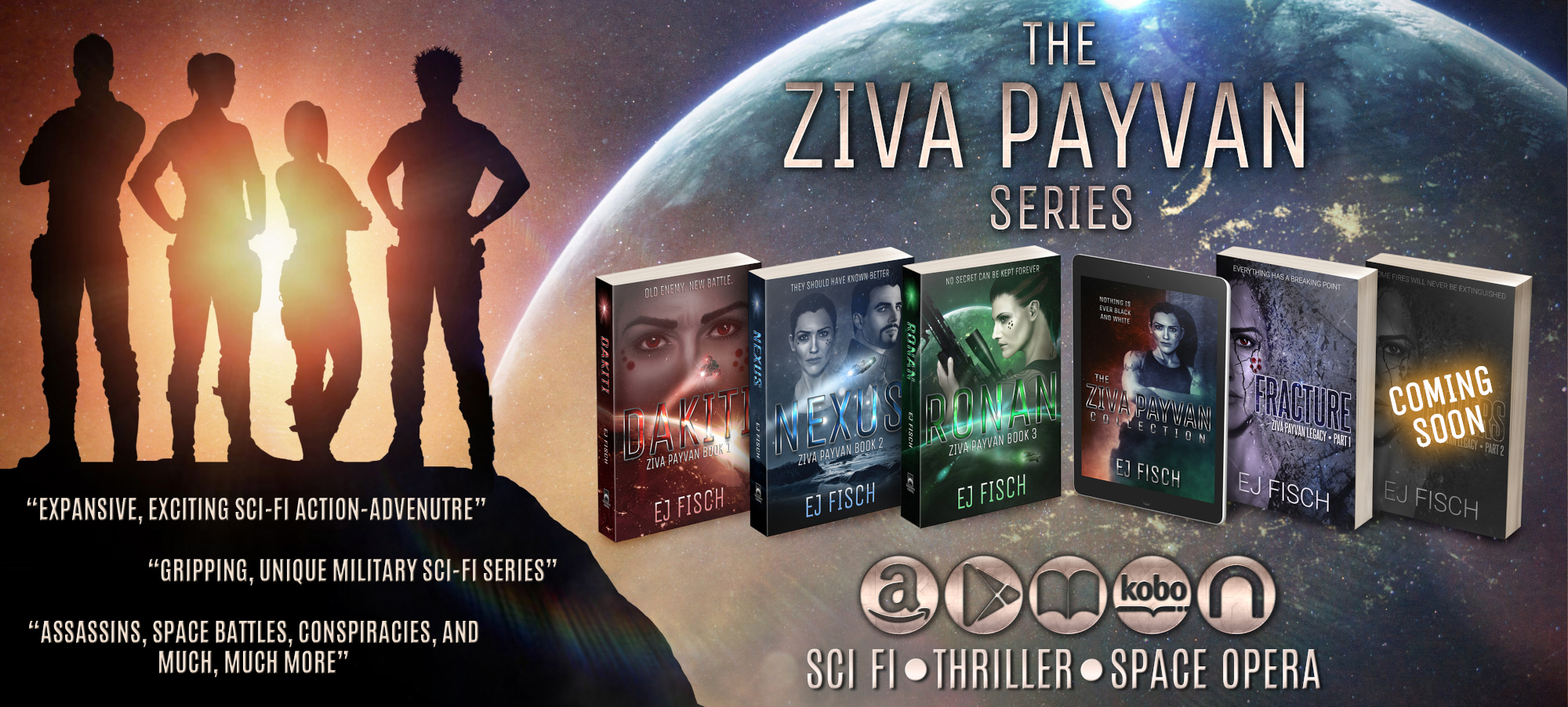
You’re right, my sci-fi comes with a twist. My current series, of which Dakiti is the first book, is character-driven space opera with kind of a spy/military thriller twist—lots of action and intrigue, but happening in a fictional galaxy with a cast of superhuman characters. All of my future story ideas are also sci-fi but have varying subgenres like post-apocalyptic and cyberpunk.

Tell us about your books and where we can get them!

team banner NEW

My Ziva Payvan series—the aforementioned space opera/spy thriller mashup—is currently available on all major ebook platforms and in paperback. The saga begins with an elite operative (the series namesake Ziva Payvan) being forced to team up with the brother of a man she killed in order to stop a threat to their world. Shenanigans ensue. The main trilogy consists of Dakiti, Nexus, and Ronan (+ an omnibus edition containing all three), and then there’s Fracture: Ziva Payvan Legacy, Part 1. Embers, which is part 2, is still in the works and I’m aiming for a year-end release. While all five books are technically part of the series, I consider the two Legacy books kind of a collective sequel to the main trilogy.

I really enjoyed Dakiti, and I was shocked when I heard when you wrote it! Can you share with readers when you started writing?

I’ve been writing to some extent since I was probably 10 or 11, but I didn’t really start writing “seriously” until I was in junior high and even high school. A couple of friends and I had this goofy Star Wars roleplaying game going via AOL instant messenger in 7th and 8th grade and I used to take our chat transcripts and novelize them. It was at that point that I started to think, “Hey, I could probably write a real novel-length story if I wanted.” I started developing some new characters and some new plots and experimented with some little one-shots. I actually wrote the majority of Dakiti during high school, then spruced it up fairly extensively a few years ago when I decided to pursue publishing.

Seems like writing has been a part of your life for a long time. Why do you write?

Frankly, I think I’d go insane otherwise. I admittedly have a very a vivid imagination and am always thinking “what if,” so creating new worlds and characters is a constructive way for me to explore all of those ideas. Writing just feels like the natural solution. It’s an outlet.

Are you a plotter or a pantser?

I gave pantsing my best shot when I first started developing the two Ziva Payvan Legacy books, and looking back on it, I really should have known better. I’m a plotter at heart, and I ended up wasting an enormous amount of time (we’re talking like three years—yikes) before I finally went back and wove what little material I had into a detailed outline. After that, I was able to progress much more smoothly. An outline serves as a roadmap for me, and I’ve always had to at least have a high-level list of major scenes/events before I even begin a new project. As I’ve worked on Embers, I’ve created an outline for each chapter, leaving space for extra notes because it never fails that I come up with more ideas for little details I don’t want to forget. I’ve really enjoyed using the GoodNotes on my iPad so I can sync it with my phone and jot things down wherever I am.

How do you fit writing into your life? 

I have a day job, so it can sometimes be tricky to fit writing into my schedule. When I’m really on a roll, I usually don’t have much trouble finding the time, but more often than not, writing is competing with several other hobbies for the limited free time I have. I’ve gotten to where I do all my drafting in Google Docs so I can access my work from pretty much any device at any time, and I think that has really helped. Even if I’m not actively working on the story, I’m still connected to it.

It’ll take me a bit to get through the books you’ve already published, but can you share anything about your upcoming projects?

Embers is definitely my primary project right now and I’m planning on it being the final installment in the Ziva Payvan saga (with “planning” being the keyword—I wasn’t originally “planning” on Fracture and Embers even existing, but here we are). One of my future ideas is for a semi-comedic sci-fi adventure/heist story I’m describing as “Ocean’s Eleven in space,” and then I’ve got a space-opera-meets-post-apocalyptic story idea that will involve a bounty hunter guild and a character who belongs to another race featured in my current series. Then there’s kind of a near-future-Earth cyberpunk/psychological thriller idea I’ve actually had longer than the others, but it’s not as big of a priority as they are.

Currently, one of my biggest dreams is to have my books adapted into graphic novels. I’ve been really into the Lazarus graphic novel series by Greg Rucka, and every time I read it, I think my material would be perfect for that sort of thing and I imagine how cool it would be to see it visualized on the page. It’s one of those things that I could probably do myself if I tried, but it would take me a thousand years and I’d have to devote all my time solely to that project. And if someone else was developing it, I’d be hovering constantly to make sure it was done the way I wanted. So while it’s a nice dream to have, I’m not taking it super seriously at the moment.

I don’t tend to read graphic novels, but I can see how your books would fit really well, and it would be really neat to see visual representations of the different species and their characteristics. You mention you’d do it yourself – are you an artist as well? What other hobbies do you have? 

Yes! Digital art is a big hobby of mine. I do all of my own cover art and concept art, so even when I’m drawing instead of writing, chances are it’s still somehow related to the story. I’m also a sucker for story-based RPGs, but gaming is dangerous because if I get caught up in a new game, I typically don’t get anything else done, regardless of how much I want to. I keep saying I’ll have to make myself finish Embers before Assassin’s Creed: Valhalla comes out this holiday season or it’s never going to get done. Ha! And, of course, reading, but that tends to fall by the wayside a lot.

What’s your favorite genre to read? Favorite books?

They say write what you like to read, so it should come as no surprise that I enjoy reading a) sci-fi and b) thrillers (bonus points for a combination). Space opera is definitely my favorite sci-fi subgenre, but I’ll read most types of sci-fi if a given book’s premise grabs my attention. I love Hugh Howey’s Silo trilogy and have enjoyed a number of space opera works by other indie authors, such as G.S. Jennsen’s sprawling Amaranthe saga and Joel Shepherd’s Spiral Wars series (which I’ve fallen miserably behind in, I fear). My CP T.A. Hernandez also has a great dystopian thriller trilogy with a dash of sci-fi. On the purely thriller side, I’ve really enjoyed David Baldacci’s Will Robie series (government assassins, anyone?). The plots feel a little far-fetched at times, but the two protagonists are wonderfully written.

What do you want readers to know about you?

I’m always up for connecting on social media (links below). I’m happy to discuss my books, characters, or just chat about writing and reading in general. And it’s always fun to connect with people over other random mutual interests. Sometimes it feels like I spend more time tweeting about video games and cats than I do about books.

Thank you so much to EJ Fisch for taking the time to answer my questions! Please check out her website and find her on twitter, Facebook, Instagram, Pinterest, and Goodreads.

Also, buy her books from Amazon, Barnes & Noble, Apple Books, Kobo, and Google Play.


______________________________________________________________________________

Would you like to be featured, too? Please contact me at kristin@theedifyingword.com!