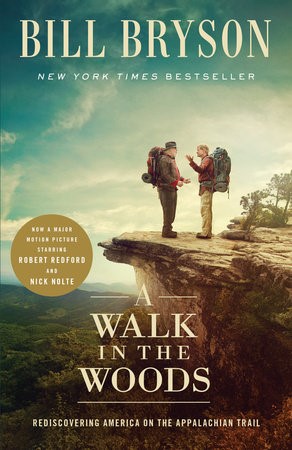
Bill Bryson’s A Walk in the Woods is an engaging tour of the Appalachian Trail and its history as well as a humorous account of two woefully unprepared men attempting to through-hike the trail in one summer. The book appealed to me because I live on the East Coast and enjoy hiking and therefore have hiked portions of the trail myself; I have neither the time nor the inclination, though, to attempt a through-hike. It also came highly recommended by my in-laws, who listened to the audio book years ago. I finally picked it up after the publisher rereleased it to coincide with the movie release.
If you are looking for entertainment, the book does not disappoint. Bryson imbues the entire book with a light-hearted levity teetering on the edge of just being over-the-top. He makes fun of himself and others with equal ease as he recounts his hiking adventures; indeed, this is where Bryson is at his best. The most engaging part of the book is the story, and Bryson never takes himself too seriously. The reader watches him prepare for and begin hiking the trail, decide not to through-hike after all, but then doggedly continue the trek as he hops from place to place along the trail. I found myself admiring his perseverance, and I can’t be disappointed that he doesn’t finish the hike—did I mention that I don’t even want to try it? Near the end, he reports his final tally: 870 miles, “just” 39.5 percent of the trail. I nodded in complete agreement and awe as he concludes, “If I had hiked that against almost any other measure, we would all be feeling pretty proud of me now” (273).
The next strongest and most interesting part of the book is Bryson’s recounting of the history of the trail itself and his commentary on conservation (or lack thereof) along the trail. As I mentioned previously, I have hiked portions of the trail, mostly in Virginia and West Virginia, and so learning about its development and building was very interesting for me, as were brief histories of places in the Virginia area through which the trail passes; Shenandoah National Park and Harper’s Ferry were of particular interest. I was less interested in histories of areas outside the trail in Pennsylvania coal country; these felt tangential to me, but that could be because I have no personal connection to the area. In terms of conservation, the book is full of statistics and species-specific information, which mostly seems impartial. Bryson does get a little heated in his apparent disdain for the National Park Service, which he seems to think inept, admitting, “now you might conclude from this that I don’t much admire the Park Service and its people” (93).
Though I enjoyed the book overall, I do feel the book disappoints in one glaring way: the statistics sprinkled throughout the book are very outdated. Bryson hiked the trail in 1996 and the book was originally published in 1998. His story and the history portions, of course, are still relevant, but his conservation statistics are outdated. Neither he nor the publisher made any attempt to update the information; there isn’t even a foreword in the new release explaining this fact. It left me feeling like the rerelease was pure commercialism – a chance to sell more books as the movie hit theaters. This may, in fact, be true and there’s nothing objectively wrong with it, but I wish the information had been updated.
Overall, I found the book very entertaining and definitely worth reading. I enjoyed it, and I think anyone who enjoys hiking, nature, or the Appalachian Trail would like it. I give it 3 stars!
Additional information and links:
Penguin Random House links:
*Note: I received this book from Blogging for Books for this review.
 by Sandra Boynton
 by Russell Hoban (I haven’t read this.) (UPDATE – I have now. I liked it – it had a good message about not being jealous when it’s your sibling’s birthday. It was a bit advanced for my kids, though.)
 by Pat Hutchins
 by Marie-Louise Gay — I really enjoy this one. I can sort of relate to Stella as the big sister (and now, as Mom) being asked SO MANY QUESTIONS. I felt compelled, though, to tell my kids which of Stella’s many explanations to her younger brother are just wrong. Now they point it out to me, which makes me proud. I can’t have my kids going around saying starfish are stars from the sky that learned how to swim. 🙂
 by Leslie Harker (I haven’t read this, either. That needs to change.)(UPDATE: I read this, too. It’s a great adaptation of the Biblical Noah’s Ark, with Annie as Noah’s granddaughter, with him on the Ark.)
 by Julian Scheer
 by Marilyn Singer — My four-year-old likes Tallulah a lot; this is the second Tallulah book we’ve borrowed recently. She doesn’t seem to want to read the actual story too often, but it’s the sort of thing she will just bring up out of the blue weeks down the road. I think it’s because she finds ballet intriguing.
 by Tim Egan — We REALLY like this one, kids and parents alike. It’s a silly story about a farmer whose animals leave because he’s too serious, and the illustrations (check out the animals’ eyes!) are perfect! I can’t help but enjoy the larger lesson-learned here more than anything else: “‘Well that’s no way to solve a problem,’ said Farmer Fred. ‘You don’t just leave…And, besides, we’re a family.”
 by Robert Lopshire — If we owned this book, I think we’d read it over and over and over and over. The kids just love it.
 by Lisa Campbell Ernst — This is a great story about Goldilocks returning to “fix” what she messed up at the bears’ cottage- 50 years later! The kids love it, even though they don’t know the original Goldilocks story well enough (or at all?) to understand what’s going on. This is another one with perfect illustrations; I’m beginning to wonder if they’re just better when the author is also the illustrator.
 by Charles Fuge — This is about a little girl and her stuffed animals. It’s fun, and the kids seem to really enjoy it.
